Visionaries: Tristan Auer on designing sur mesure, crafting hotels, homes, furniture and car interiors
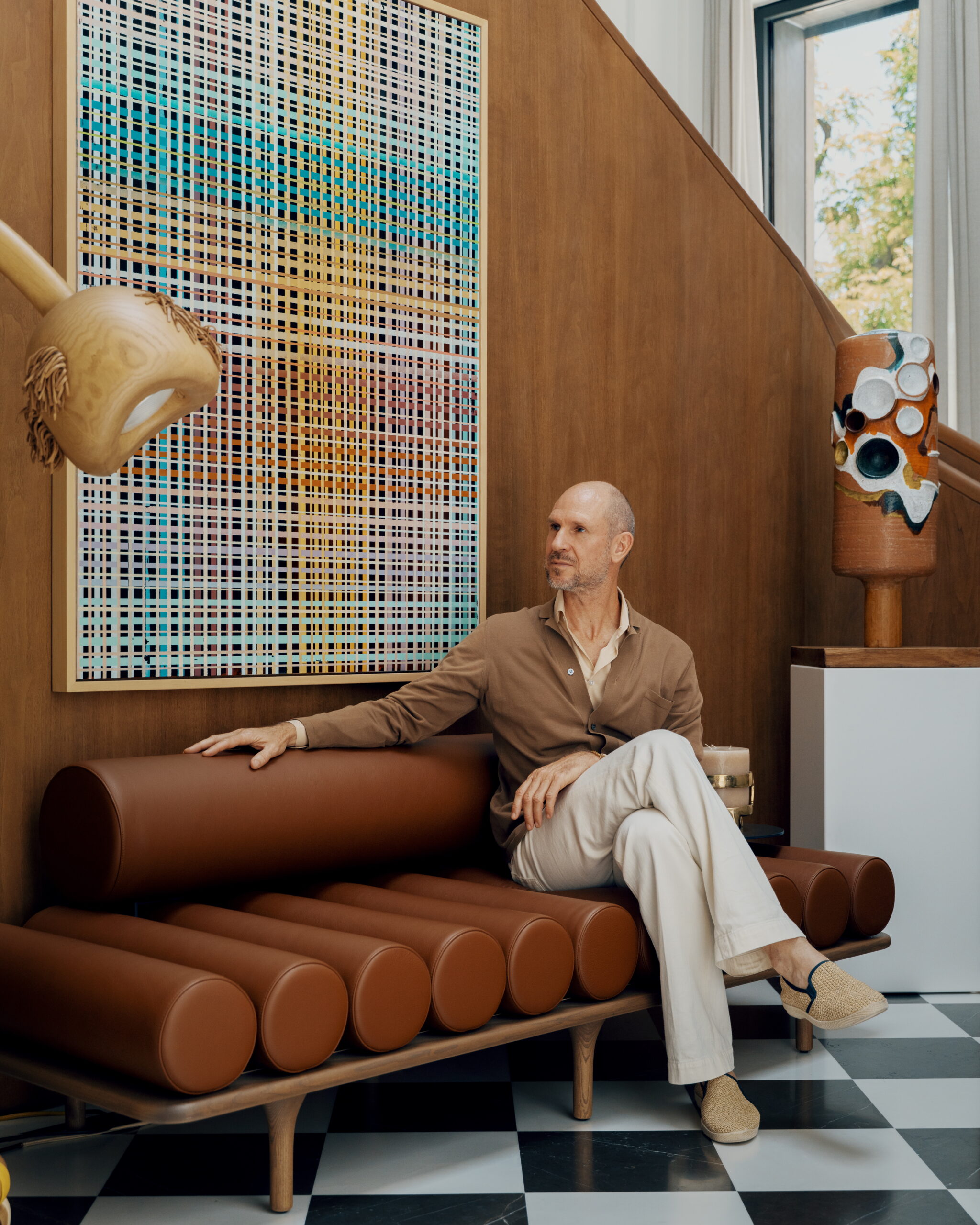
As the visionary behind some of the industry's most recognisable hotel projects, SPACE sits down with the interior architect, Tristan Auer, who swapped out a signature style for boundless design
WORDS BY JESS MILES
Ask Tristan Auer what makes a project unmistakably his, and he won’t point to a palette, a material or a recurring style. "Perhaps the consistency of the approach rather than a recognisable aesthetic," he says. "I work sur mesure – like a tailor, assembling references, pieces and details that together embody a space and the personality of whoever inhabits it." Despite no distinct look, a greater measure of his work – and perhaps for every designer – is how he builds the worlds of his projects. For Auer, the philosophy is the constant, always reaching toward a subtle balance between eras and styles, mixing classical references with contemporary design. Sometimes the balance is harmonious, sometimes intentionally dissonant.
“That thread runs through everything,” Auer shares, “whether I'm designing a private home or working on a palace or a car. The project changes, the culture changes, the client changes – but that way of reading a place and its story never does. ”Auer is currently working with 16 hospitality brands across five continents, alongside private residences and more unexpected territories – yachts, and car interiors through his dedicated practice, Car Tailoring. His hotel projects run from grand European institutions to an alpine chalet for Rosewood and a boutique hotel in the Marais – and, most recently, the commission that may define this chapter of his career: the first restoration project Dubai has ever seen, of the iconic Jumeirah Burj Al Arab.
While today’s project pipeline is an impressive feat, Auer’s work has always been high-calibre, even from the beginning. Having trained at the prestigious ESAG Penninghen in Paris before joining Christian Liaigre and then Philippe Starck – he had an education of dreams for a young designer, split between two of the most influential yet least similar figures in French design. "Looking back, what strikes me most is how formative those years were – not just technically, but in terms of how to think about a project, how to inhabit a creative culture," he reflects. Where others might have absorbed a style, Auer absorbed a discipline.
"I took from these two founding influences a demand for detail, the precision of drawing, and a creative freedom without dogma," he says. "Everything was different between them – this is what I was looking for, not embracing a style but more sharing a culture and a way of thinking through a project." When he founded his own studio in 2002, that appetite for boundless design was the guiding ethos, and one that still shows across his portfolio today. "I was certain of one thing – that I needed creative freedom. No filter, no imposed direction, just the space to follow my own instincts wherever they led." The rest, he says, "arrived the way most good things do – not quite by chance, but not entirely by design either.
The right encounters at the right moment, projects that opened doors I hadn't thought to knock on. "With such a diverse portfolio, it’s easy to wonder how the different typologies inform and impact each other, and whether a designer might risk spreading themselves too thin. Few interior architects will move between the public rooms of a palace hotel and the cabin of a car in the same working week, but Auer finds the challenge liberating. "I've always been drawn to the boundaries of what design can be – the idea that the same intention, the same sensibility, can be compressed into a car interior or expanded across an entire hotel. The scale changes, the constraints change, but the question remains the same: how do you create an experience that feels inevitable, that could only exist in this precise form?"
Auer works as an ‘ensemblier’, composing the complete interior – from the architecture of a room down to the objects on its shelves – as a single act. Having worked across hospitality, residential, furniture, product and car interiors, he has learned what matters at every point on the design spectrum. “I think in terms of the whole, but the whole is only as strong as its smallest detail. A door handle, a seam, a choice of hardware – these are not finishing touches, they are where the intention becomes tangible," he says. “The different scales don't just coexist – they inform each other constantly. Hospitality taught me to think about a complete experience. The car taught me to condense that experience with even greater intensity. And both remind me that luxury lives in the attention paid to detail. Nothing should be left to chance.
”Operating at what he defines as ‘an almost radical level of precision’ inevitably shapes his view of trends and the wider industry, where the same visual references circulate at speed, and new openings on different continents from different brands can look good but feel cookie-cutter. "What I'm opposed to is the automatic stylistic reflex – designing from a mood board of the moment rather than from the specific spirit of a project. Trends are, by definition, shared. And luxury, or at least what I find interesting about it, is the opposite of shared – it's singular. "Luxury is a contentious term across the hospitality industry, its meaning often lost in the translation of trend, applied too liberally to define anything in particular. Auer’s definition of luxury as singular is a refreshing take that renders the term timeless, unmoved by the comings and goings of style.
"I think of it as haute décoration: each project conceived as a unique piece, designed for a specific place, a specific use, a specific individual. Like a tailor crafting a suit – it only works if it fits perfectly," he says. "What hotel operators often get wrong is losing the sense of place. A hotel that could exist anywhere is, almost by definition, not a luxury experience."On what that looks like, Auer says his vision of luxury “has moved away from anything visible or ostentatious and closer to emotion and experience. A sensitive, embodied luxury – made of precision, light, materials, and an extreme attention to detail. Something that is felt more than it is seen."
It is a quieter idea of luxury than the one that built many of the grand hotels he now works on, and no hotel was built on the louder kind quite like the Jumeirah Burj Al Arab. Dubbed the world's first seven-star hotel, it opened in 1999 as the ultimate statement of millennial luxury – as spectacle, designed to be seen and heard from every angle. Stood on its artificial island, its sail-like silhouette announced a new dawn for an entire city. A quarter of a century on, its interiors are as recognisable as its outline. Now it will close for its first restoration, with Auer responsible for its next era. "Being entrusted with the very first restoration of a building in Dubai – the Burj Al Arab, a timeless icon of the region – is a profound privilege," he says. "To carry forward, with the utmost dedication, the legacy of such an extraordinary landmark is both an honor and a responsibility."
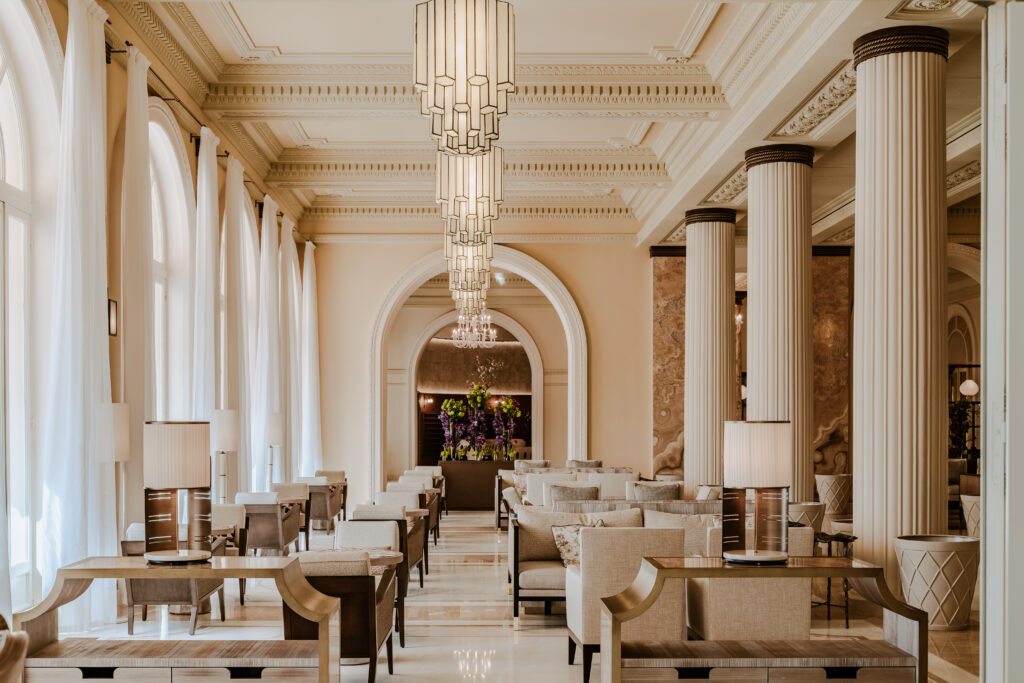
On paper, Auer and the Burj Al Arab seem an odd pairing, but in practice, few commissions could suit him better. Twenty-five years on, the hotel's futurism has become heritage, and heritage is his territory. Restoration may be a word we reserve for stucco and gilt rather than monuments to the future, but the Burj Al Arab could exist nowhere but Dubai, and that singularity is what Auer has spent his career pursuing. Much of Auer's portfolio rests on projects that arrived with their history written – the Hôtel de Crillon and Les Bains in Paris, and the Carlton Cannes on the Riviera, for example. When asked what an inherited space offers that a new build cannot, his answer is simple. "An inherited space gives you a conversation partner. A blank slate is a monologue." "When history is already present in the walls, the material, the proportions – your job is to listen before you design. That constraint is actually a form of freedom. It tells you what the space wants to become, rather than leaving everything open and arbitrary. I never erase history – I allow it to evolve," he continues.
"A blank slate can seduce you into imposing a vision. An inherited space demands humility first – and I think that humility is where the most interesting design decisions are made." His two newest hotels show his passion for world building, and as with all his projects, look entirely different from one another. Rosewood Courchevel Le Jardin Alpin is a ski-in, ski-out chalet of 51 rooms in the most rarefied corner of Courchevel 1850, where Auer answered to the resort's own mythology. "Courchevel carries eighty years of alpine audacity – a glamour inherited from its golden age that asserts itself powerfully. The ambition was to honour that legacy while projecting it into a new era. Not simply a hotel, but a high-altitude residence embodying a new kind of luxury – emotional, absolute, yet respectful of the mountain's rawness."
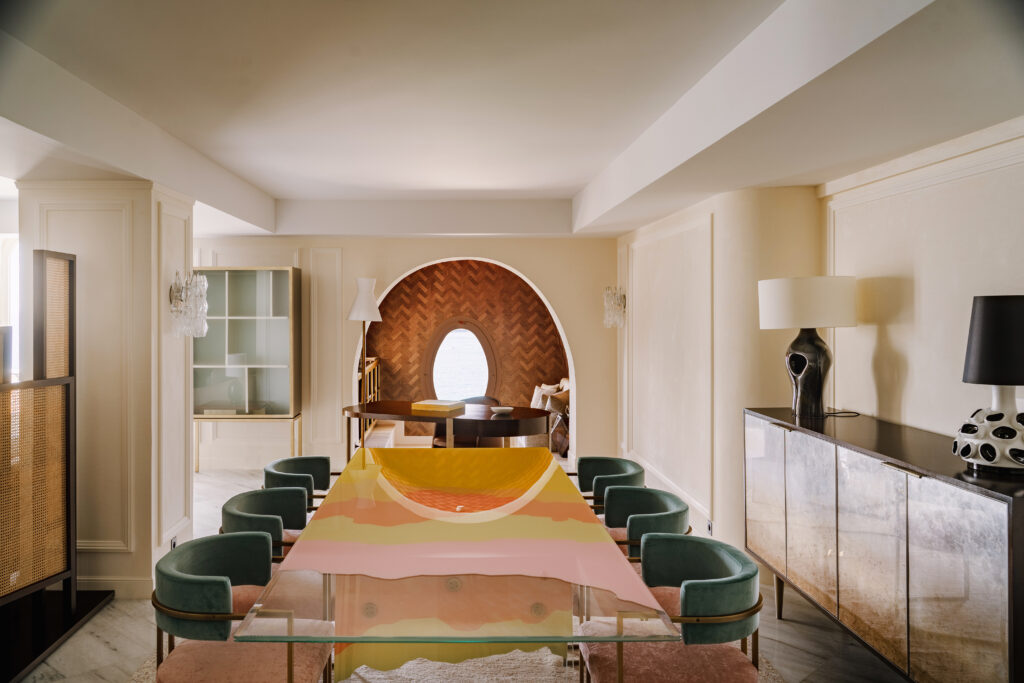
Experimental Marais, a 43-room hideaway on rue du Temple in Paris, similarly draws inspiration from its locale, though this time Auer built out the story around an imagined protagonist. "I started with a character – a distinguished, visionary man who travels on his own terms, never seeking to define himself through labels. The hotel is his Parisian anchor. I approached it like a film director: you move through the space frame by frame, carried by a constant pursuit of elegance and emotion. "A mountain resort built on history, and a Paris hotel built on a likely character. "Two projects, two completely different narratives – but the same method underneath: listening to the place, building a world around a singular identity, and never imposing a style from the outside.
"Away from the drawing board, he is assembling a retrospective of his own story – a first monograph, due in the latter half of 2027, that asks him to turn his own method on himself. "It's a truly humbling experience – looking back at twenty-five years of work and thinking carefully about how to bring the reader into that narrative, to make them a genuine part of the journey. "In terms of future ambitions, having compressed his craft into the cabin of a car, he wants to stretch it along a railway line. "The logical next step, the dream, would be a high-speed train. Same intention, different magnitude," he says. "At heart I am a dreamer, even when awake. Every passion, every hobby, is a gateway – a way of feeling the world more intensely and transmitting that richness into the spaces I design."
Related Articles
Boronkay Studio channels Art Deco elegance at Hôtel Palais de la Méditerranée
Boronkay Studio has reimagined Hôtel Palais de la Méditerranée in Nice, creating a contemporary i...
Read more
Portugal, built to last: the country’s next wave of hotels
Beach holidays on the Algarve, weekend breaks in Lisbon and Porto – Portugal’s appeal has never ...
Read more
Visionaries: Aaron Clarke and Marta Tuneu, the duo behind ADC & Tuneu
Once at the helm of Soho House's design team, Aaron Clarke founded ADC & Tuneu together with his...
Read more
We'd love to hear from you! Click the button to open the SPACE Magazine Survey and have your say.

Make sure you don't miss a single issue of SPACE by subscribing to receive the magazine. Click the button above to signup.