Visionaries: Kelly Hoppen CBE reflects on a career at the forefront of design

Her neutral palettes redefined contemporary interiors. Now, in conversation with SPACE magazine, Kelly Hoppen CBE considers the vision, ambition and longevity behind her enduring influence
WORDS BY EMMA KENNEDY · PROFILE PHOTOGRAPH BY DAVID VIENNI
There are few figures in contemporary design whose name – and aesthetic – are as instantly recognisable as Kelly Hoppen’s. Composed and self-possessed, she joins me from her London studio, her mass of curls as familiar as the neutral palettes she helped popularise. “I’m actually in the executive suite,” she tells me, scanning her surroundings. “Though God knows why it’s called that.” Possibly because she’s worth it? I offer.
With decades of accolades, award-winning projects, bestselling books and television appearances behind her, it’s hard to know where to begin. But with design at the core of everything that followed, her first venture into interiors seems as good a place as any – and she obliges. “My first job was a family friend’s kitchen when I was 16 – but to be honest, it was a complete disaster,” she admits. But it’s not the outcome that interests me.
Sixteen is young; confidence, I assume, wasn’t in short supply. “God no – it was the absolute opposite,” she says. “My father had just died, I’d been hugely bullied at school, and had no confidence at all. But I was fortunate enough to have grown up in a home exquisitely designed by my mother. My father was in the fashion business, and we were surrounded by creatives – poets, artists, ballerinas – and our door was always open. It was quite a bohemian upbringing. All I knew was that I loved the arts and believed in my ability to design – or at least learn how to design.”
Undaunted by the kitchen disaster, her next project was the home of a racing driver – a connection made through a friend. More drivers with houses in urgent need of decoration followed apace, and soon her name was flying round the circuit. Actors and musicians followed, along with a growing network of specialist craftspeople keen to contribute to her projects. With her father’s inheritance, she bought her first car and flat; with her mother’s business guidance, she built the foundations of a career.
As she closes what feels like part one – the early years – she smiles. “In truth, I couldn’t see. I was literally finding my way in the dark.” Within minutes, Hoppen has painted a remarkably clear picture of how it all began. Still in her early twenties, the project that launched her into the public domain was her own. “I had just got married and was pregnant – and we had bought a house in Kensington, which I’d done up. I had it photographed by Fritz von der Schulenburg, and it went into House & Garden. That really was a moment for me.”
Recognising early the power of publicity, right from the start she has invested in PR support. “I’ve learned a lot about PR and marketing – I’m no novice – but if you’re busy doing what you’re doing, it’s really important to have somebody support you and help you in that way.” Having achieved so much in a relatively short period of time, I ask Hoppen whether that level of industry recognition would still be possible within such a timeframe today. “I think if you’re clever, as I was, you could probably do it even quicker now with Instagram and social media. The difference is that what I was designing was fresh and new – no one had seen it before. I created it entirely out of my own head, whereas today everything is what I call a ‘fake collaboration’. In other words, someone sees something on Instagram and essentially copies it.”

“I discovered blue-and-white china and jade – and after that, I became obsessed with Japan. I fell in love with obis, I love their linear lines. They just make me feel good, and they still feature in all my designs.”
Although that aesthetic has naturally evolved over her decades in design, its key ingredients remain. Her first book, East Meets West, a response to her discovery of – and subsequent love affair with – Eastern art and culture, was sparked by a chance find on Portobello Road. “It all started when I found an old, lacquered trunk. I bought it, took it home, and began researching the history of Chinese lacquer work in libraries. Then I discovered blue-and-white china and jade – and after that, I became obsessed with Japan. I fell in love with obis. I love their linear lines – they just make me feel good – and they still feature in all my designs.”
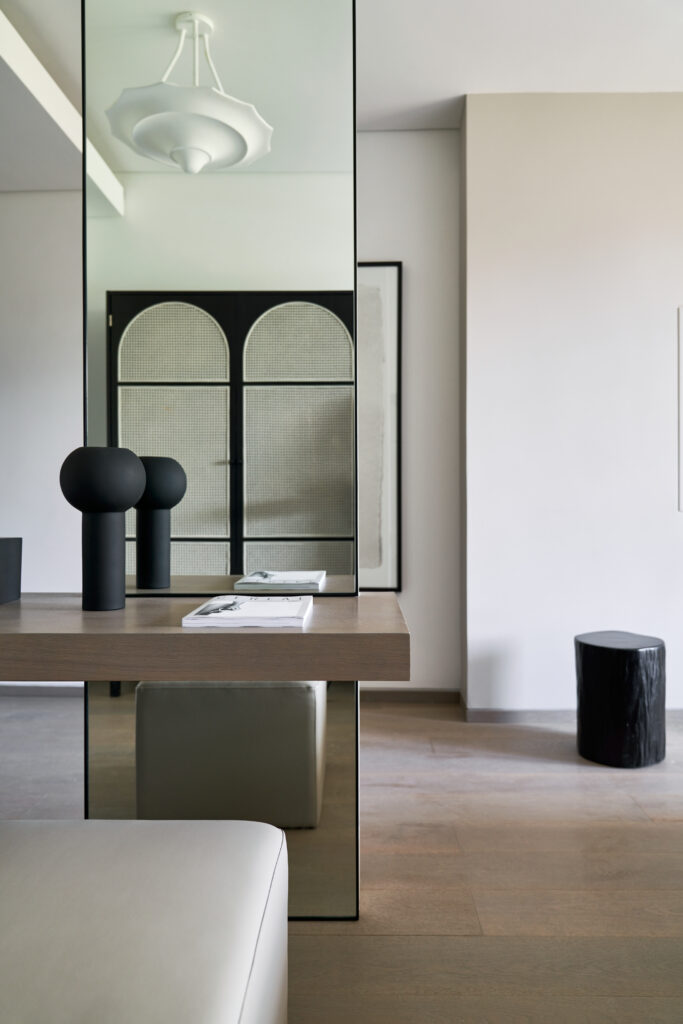
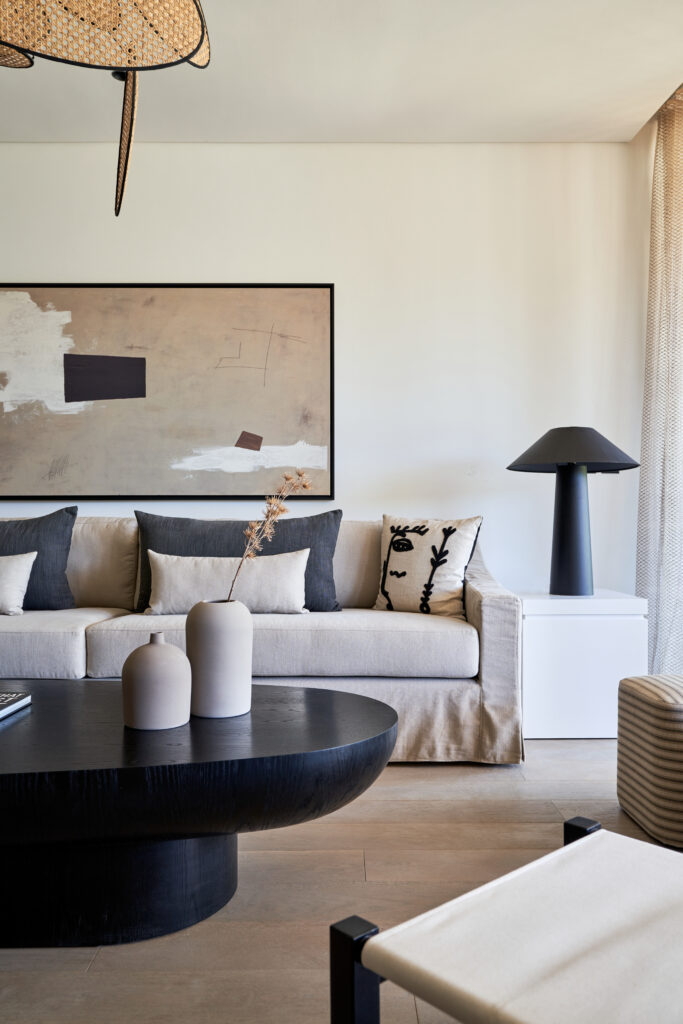
Lux Grand Baie Resort, Mauritius
Despite the publisher’s reluctance over the book’s title – “They told me it sounded like a restaurant chain” – in true Hoppen style, she won the battle, and the book became a bestseller. It felt new and exciting and as I recall, offered a welcome reprieve from the busy chintz and farmhouse chic that held sway in much of the ‘90s interior landscape. “Queen of Taupe” is a favourite trope – one that suggests a blandness simply not evident in her vast portfolio. Does it bother her? “Oh, God no – I love to be controversial!” she laughs. So how would she describe her style?
“Okay. Well, first of all, it’s not that I don’t like colour, but my ethos is that your base palette should be neutral. Your bedrooms should always be neutral. I’ve been barking on about this since East Meets West – neutrals are better for people to live with, for their mental health. It’s about finding that balance. I do use colour, but not on the walls. I think colour is a movable feast, whereas neutrals are calming and easier to live with. I believe we should aim for longevity in our homes – not have to keep changing them and spending money on them. And I don’t think you can do that with a lot of colour on the walls.”
“There are great designers out there, like Peter Mikic and others, who are the complete antithesis of me – and I love what they do – but for me I need to be in a neutral environment.. So yes, my style is predominantly this calming, neutral, purist approach that is also very eclectic. You can have pink and red and orange and green – whatever you want – but you are the boss of how you move that around over time.”
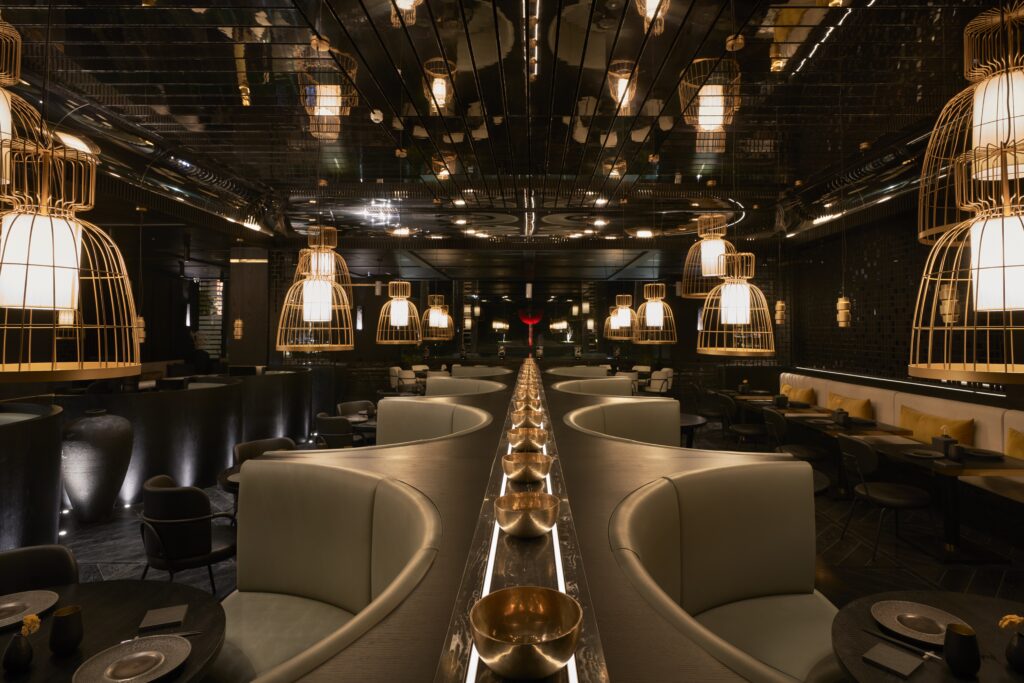
Having made her name in the homes of the rich and famous, she later crossed over into hotels, yachts, cruise ships, airlines and private jets. Can she remember when and how the crossover happened? She thinks hard. “No, I can’t actually remember what is was, but someone probably just offered me a job.” She tells me with a frankness I’m beginning to enjoy.
“I think it’s very difficult today, and I think it’s wrong – that if you’re not known for hotels, you don’t get put forward for them. We’re designing a beautiful hotel in Puglia at the moment – it’s dreamy – and I feel that coming from the residential side, I’m fully fledged in knowing what people want. It’s all a learning curve to begin with. But one of the things we do really well here is ideation. We’re good at coming up with ideas for people and their businesses – whether it’s their uniforms, their branding, what it smells like, what it wants to feel like. We do that with private clients, so it just becomes magnified when you’re doing it for a larger space, for people you’ve never met.”
“Whoever the client – private or commercial – the first thing is to meet them and literally dive right in. We ask hundreds of questions to get the basics. And then, for me – and it’s the same for the team – you just get a sense. You know when you’ve got it. You think, ‘Okay, I can go and do that now.’”
With so many design strings to her bow, the offers and invitations that come her way are many and varied. From the outside, her acceptance rate appears to be quite high, and I wonder whether she finds it hard to say no. “Some days I can definitely say no!” she laughs. “I like to work with the kind of adrenaline buzz that isn’t bad for your health – where I’m not constantly on edge. I prefer to be calmer and take more time to look at things – it’s a much better place to be. But yes, a challenge is good, because I think it gets people – and creativity – moving.”
So, stepping into the unknown is OK? “Oh God, yes. If everything was the same, I’d be bored senseless.”
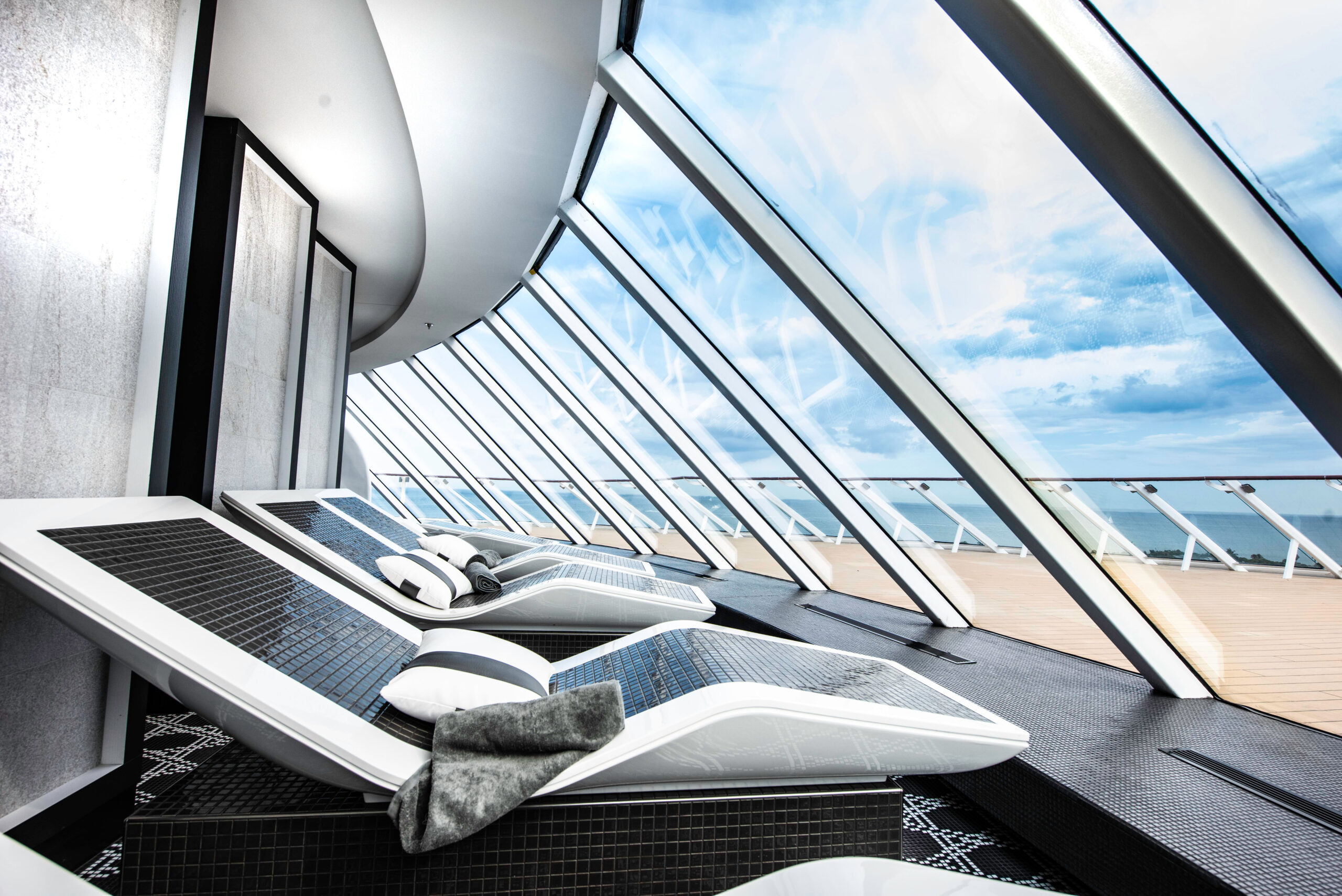
Currently keeping her from a life of senseless boredom is the hotel in Puglia, and a swathe of projects that will be revealed in the fullness of time. “I think right now, we have about 12 projects on the go, and we’re about to sign another five, all at different stages. Some of them have been in progress for five years, so we slot them in, and avoid taking on more than we can do. We have some amazing new work – but you know, I suppose my dream is to have a hotel that isn’t on a beach. I’ve never done a city hotel.” She volunteers, before correcting herself, “…Actually I did one in Barcelona – but I haven’t done one in a while.”
Alongside the interiors, product design is also a mainstay. Following on from the success of her debut collection of homewares for Marks and Spencer, she is currently at the drawing board sketching up another collection for 2027. “It’s one of the biggest joys of my life. I’m loving it. It’s just brilliant. The team are fantastic and I just find it really exciting. My father actually manufactured suiting for M&S- so it’s something I’ve always wanted to do.” She smiles.
The interview winds down, and I leave her to return to her sketching. I ask her if there’s anything else she would like to add – perhaps something she wanted to mention that we hadn’t covered. She thinks and shakes her head. “If anyone’s interested, just give them my phone number.” The line is delivered lightly, but you suspect she means it. Even after decades at the top, Kelly Hoppen is still curious, competitive, and entirely unretired. For someone who once described herself as “finding her way in the dark”, she now moves with unmistakable clarity – still saying yes to the right kind of challenge. Boredom, clearly, isn’t on the mood board.
Related Articles
Boronkay Studio channels Art Deco elegance at Hôtel Palais de la Méditerranée
Boronkay Studio has reimagined Hôtel Palais de la Méditerranée in Nice, creating a contemporary i...
Read more
Portugal, built to last: the country’s next wave of hotels
Beach holidays on the Algarve, weekend breaks in Lisbon and Porto – Portugal’s appeal has never ...
Read more
Visionaries: Aaron Clarke and Marta Tuneu, the duo behind ADC & Tuneu
Once at the helm of Soho House's design team, Aaron Clarke founded ADC & Tuneu together with his...
Read more
We'd love to hear from you! Click the button to open the SPACE Magazine Survey and have your say.

Make sure you don't miss a single issue of SPACE by subscribing to receive the magazine. Click the button above to signup.