
“The Power of Self-Expression” at Hart Shoreditch
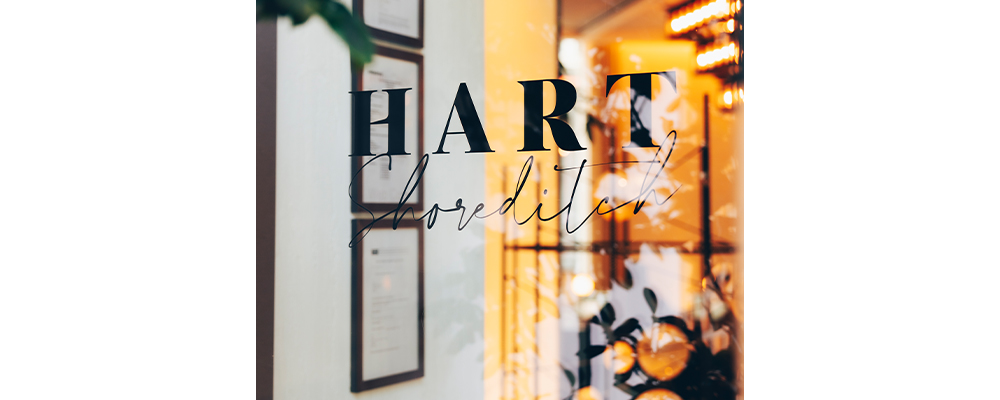
As part of London Design Festival 2025, Hart Shoreditch hosted an insightful panel talk on “The Power of Self-Expression”.
SPACE Magazine’s Editor, Emma Kennedy, sat down with multi-disciplinary artist, Rosie Reed Gold, Hart Shoreditch’s General Manager, Lina Zakzeckyte, London Design Festival’s Head of Partnerships, Rachel Hymas, and Rob Smith, Director of children’s writing charity Ministry of Stories. The discussion was centred around personal storytelling and the notion that creativity isn’t just a design choice, it’s a philosophy. Together, they explored how art, design, and storytelling intersect to shape identity, community and belonging, reflecting on Rosie’s pop-up exhibition, ‘Stage Left, Letter Pressed’, displayed at Hart Shoreditch.

Rosie Reed Gold’s pop-up exhibition, ‘Stage Left, Letter Pressed’, displayed at Hart Shoreditch.
Rosie Reed Gold:
Rosie, you’re a poet, a photographer, and a filmmaker – in short, a multidisciplinary artist who blends many practices in thoughtful and surprising ways. How have you arrived at where you are today?
Sometimes I ask myself that question with astonishment! I came to art a little later in life. I always thought of myself as an artist, but reality got in the way – I studied English and philosophy first, then returned to art in my late twenties or early thirties. That academic background really shaped my practice; a lot of my work now is textual and rooted in language.
Your work crosses poetry, photography, and performance. What does self-expression mean to you personally and how does it change depending on the medium you’re working in?
For me, self-expression is freedom. It’s about creating and communicating your version of reality. The medium shifts with each project, for instance, the work I created here is a site-specific installation, so film felt like the natural form. Expression feels even more vital today, especially in the current cultural and political climate. We’re lucky to have spaces like this to show work and start conversations about what expression means.
Your short film, made specially for this exhibition, draws on Shakespeare’s Hamlet. What was the inspiration behind it, and what do you hope audiences take away?
It’s inspired by the idea of writing yourself into being that no matter what stories you’ve inherited, you always have the power to write new ones. It’s about connection through storytelling. The interactive piece outside works on a similar principle: people can literally write their stories into light. It’s important to give both children and adults that space to express themselves, to shed old narratives and create new ones.
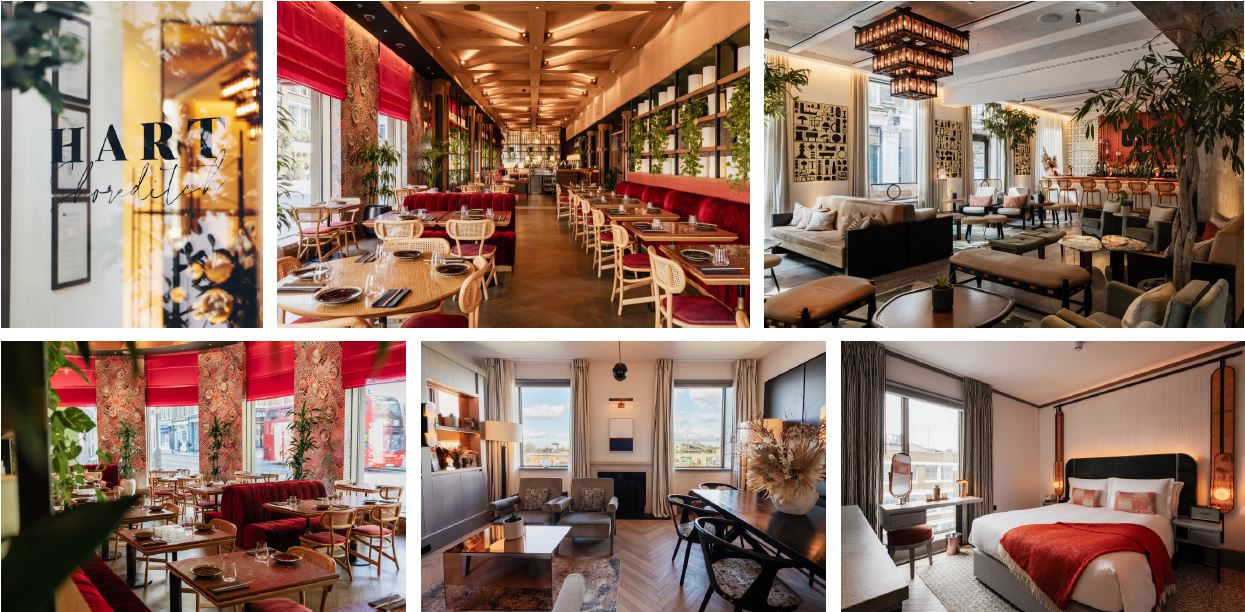
Hart Shoreditch
Lina Zakzeckyte:
Lina, as General Manager of Hart Shoreditch, you’ve made the hotel a hub for creativity – from artist residencies to local collaborations. How do design and storytelling help create a sense of belonging for both guests and the community?
It’s not just about having a beautiful design, it’s about meaning. Every element in our hotel connects to Shoreditch’s history. Guests from abroad don’t just stay here; they experience the neighbourhood’s story. That’s what gives a hotel its soul. A building without purpose is just a building. What gives it life is the energy and connection between guests, locals, and the history that surrounds it.
Hart Shoreditch is known for supporting creative self-expression. How do you see the hotel as a platform for artists and local voices?
We offer space and support for emerging artists, people who need that first opportunity to show their work. When others see that, it inspires them to take their own creative steps. I’m passionate about discovering new art. The real creativity often lies beyond what’s already known. That’s what makes it exciting. We’ve also become a hub for workshops and community projects, and we always say yes to those ideas. It’s how we keep the building alive, full of energy, creativity, and connection.
Rachel Hymas:
Rachel, the London Design Festival is now in its 23rd year – an incredible milestone. What’s the story behind its launch, and how has it evolved?
It was founded by Sir John Sorrell and Ben Evans OBE to celebrate London’s creativity, its local communities and diverse design culture. London is a city made up of many pockets, each with its own character. What I love most is that it’s grown into an international celebration.
Designers come from all over, South Korea, Brazil, everywhere to share ideas. And what makes it special is that it still celebrates local creativity too. That’s why partnerships with places like Hart Shoreditch are so meaningful. They connect global design conversations with local stories and people.
How do you see design shaping identity and community in today’s world?
I’ve always been fascinated by the journey behind something, the story that gives it life. Over the past five years, particularly post-COVID, people have become more invested in the narrative behind design. Of course, we all appreciate beautiful products and fine craftsmanship, but now audiences want to understand the why: the local communities, the people involved, the processes that bring a piece to life. There’s a renewed celebration of craft and collaboration, of things made with integrity and purpose. Sustainability has also deepened that connection. People want transparency; they want to know how something was made and who made it. That, to me, is the most exciting evolution. It’s about storytelling through design, something Lina and her team embody beautifully here.
Through your work with the London Design Festival, you’ve seen countless collaborations. How do partnerships help bring forward voices or ideas that might otherwise go unnoticed?
It’s about openness, allowing new people into the room who might not yet see themselves as part of the established design world. Some of the most exciting ideas come from emerging designers who simply haven’t had the opportunity or visibility. We try to encourage collaborations between young designers and established brands, because that cross-pollination keeps the industry alive. One of our initiatives, Launch Pads Partnership, supports young people and entrepreneurs who might not otherwise be able to afford a platform at the festival.
Space in London is expensive, and so is production, that’s why partnerships with venues like Hart Shoreditch are invaluable. They provide central, creative spaces for new voices to be heard. Seeing something fresh come to life, that’s the best part of what we do.
Rob Smith:
Rob, as Director of the Ministry of Stories, you’re dedicated to helping young people find their voice through writing. Tell us about your work and the philosophy behind it.
At the Ministry of Stories, we believe there’s a writer in every child just waiting to be unleashed. We’re based on Hoxton Street, hidden behind a shop called Hoxton Street Monster Supplies – London’s only store for the monster community! It’s a playful front, but it supports serious work: all profits fund our creative writing programmes. When children find the secret door and step inside, they enter our writing centre – a space where imagination is everything. It’s all about giving young people a voice, unlocking ideas, and helping them tell their stories. That’s what creativity and community is really about.
Why do you think this kind of self-expression is so important for the next generation?
Because storytelling is how we make sense of the world. It’s the process of meaning-making, exploring the things that matter to you, in the way that feels natural to you. We work with children as young as five or six up to teenagers of eighteen, and their worldviews are incredible. When you give young people the tools and the space to express themselves, you realise how imaginative, insightful, and capable they truly are.
Self-expression isn’t just a creative outlet; it’s empowerment. It’s how we help the next generation build confidence, empathy, and community.
Many young people don’t always have a platform. What can we all learn from how children and teens express themselves creatively?
That their voices aren’t just important, they’re essential. Our job is to amplify them through respected, professional projects. One of my favourite examples was a project called Unexpected Poetry around Hoxton. Our young people picked locations in the community that meant something to them and created poems for those places. They decided how those poems would appear, for example tied to a dog’s lead, hanging from a tree, floating in the air. Thousands of people engaged with the work, not realising it had been written by six-year-olds. That’s the power of it. Children are capable. They just need a chance to be heard.
Writing is a social act, not something you do in isolation. When 25 young writers come together, the energy is magnetic. That’s how new stories—and new confidence—are built.
Emma Kennedy:
What unites everyone here, from artists to hoteliers to storytellers is a belief in the power of narrative. Whether through design, film, or a child’s imagination, self-expression connects us to who we are and to each other.
At Hart Shoreditch, that story continues to unfold, one creative voice at a time.
Related Articles

HBA San Francisco Reimagines Luxury Cabin Experience at Fairmont Jasper Park Lodge in the Canadian Rockies
Modern interiors immersed in the breathtaking landscape of a UNESCO World Heritage Site. Against ...
Read more
The Red Sea EDITION Opens as the First Hotel on Shura Island, Pioneering a New Era of Hospitality in Saudi Arabia
EDITION expands in Saudi Arabia inviting discerning travelers to uncover one of the region’s most ...
Read more
25hours Hotel The Olympia, Sydney, NSW Opens Its Doors
Oxford Street enters a bold new era with the official opening of 25hours Hotel The Olympia, a proper...
Read more
Anthology by Style Library Contract
Testimonials
“SPACE has excellently researched, well-rounded, and informative editorial, presented in a stylish glossy layout, which is ideally suited to the calibre of our clients. The team, both editorial and advertising, are knowledgeable, helpful, and fun. Working with them is always a pleasure.”
Karen Brooks, Esprit Media Ltd
“Working closely with Space magazine, means that Barlow Tyrie products are seen by the right target audience and relative to premiere outdoor garden spaces.”
Steven Still, Barlow Tyrie
"Armourcoat has partnered with Space Magazine since launch in 2015, and is now regarded as an essential part of our international marketing strategy. Recognising the scale of subscribers and quality of content, we truly value the opportunity the platform (both in print and digital) presents."
Daniel Nevitt, Armourcoat
"We have partnered with SPACE Magazine since it’s launch and SPACE have now become one of our most influential media partners. Their readership of senior hoteliers and interior designers are exactly the audience we invite to attend the Independent Hotel Show and SPACE delivers on helping us position our brand in front of them. Not only does SPACE have the readership we want but they also work with us to tailor content they think is right which when time poor is much needed. I couldn’t recommend SPACE enough."
Sam Chance, Fresh Montgomery