Step in to Maison Heler, a 19th-century bourgeois-style mansion by Philippe Starck
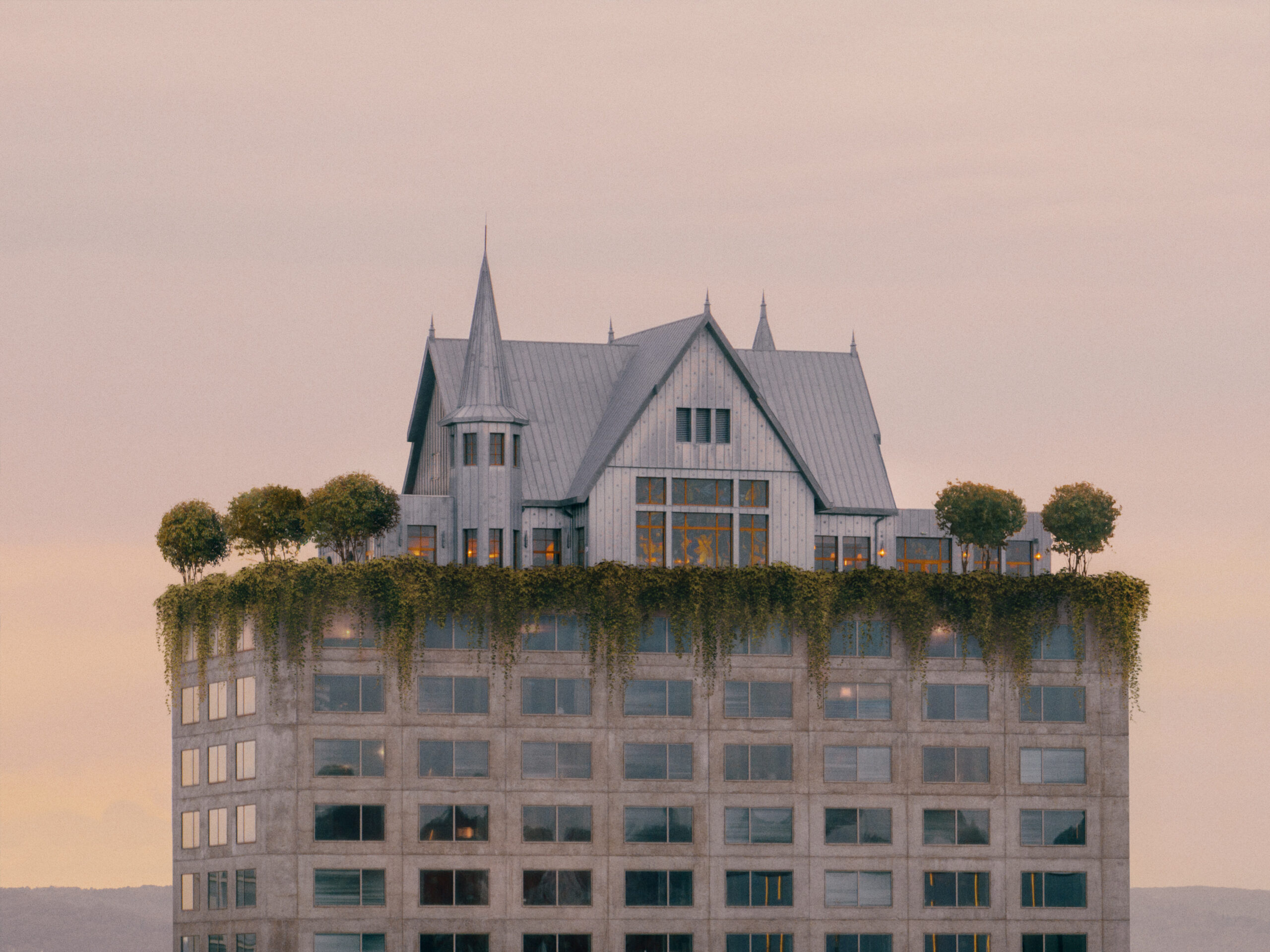
Philippe Starck has built an entire hotel around a fictional character of his own invention. In Metz, under the Curio Collection by Hilton, Maison Heler carries its surreal premise all the way to the roof
WORDS BY SPACE EDITORIAL
Upon first glance, it's hard to know whether Maison Heler is a picture of fantasy or reality. When it comes to a Philippe Starck project, the answer is quite commonly both. Starck's premise for his latest project, which is very much real, is spun out in a novel he wrote to accompany it: that a bored inventor named Manfred Heler was lifted skyward one day with his house and garden intact, "as if a cookie-cutter had arrived from below, cut off the earth's cap and mounted it vertically," Starck says.
A monolithic, metal-clad tower of nine storeys rises from the Amphithéâtre district beside the Centre Pompidou-Metz, and perched on top, complete with steep zinc roof and spire, sits a house in the manner of the region's 19th-century mansions. In a city already layered with Romanesque, Gothic, Renaissance, Baroque and Art Nouveau, the addition feels like one more ornate era added to the mix.
It is the furthest Starck has pushed his imagination into reality amongst recent hotel projects, this time building the architecture around a story rather than dressing the interiors as an imaginative set. At Mondrian Bordeaux Les Carmes he turned a neo-Gothic wine warehouse into a five-star hotel staged as a meeting of West and East, a Japanese restaurant folded into Bordeaux stone. At Evok Collection’s Brach Madrid, which opened not long before Maison Heler, he furnished the rooms as if by a man filling his lover's home with objects remarking their romance – a guitar here, a tambourine there. The sky is the limit for Maison Heler's story, which begins for guests the moment they look up from the street below.
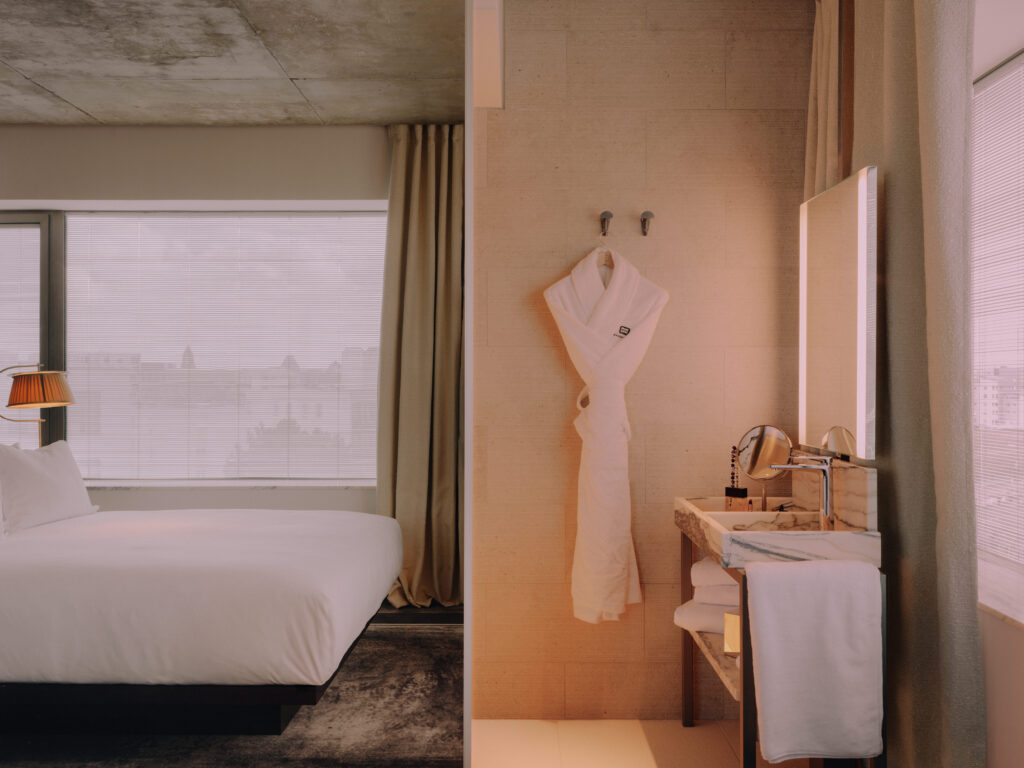
Inside, the 104 rooms, spread across floors two to eight, are stripped back to what Starck calls "an almost Spartan spirit, stripped of any superficiality, where each material asserts its own colour: the white of cotton, the grey of concrete on the ceiling and walls." Expansive marble panels and sliding mirrors bring the brutalism, while plush carpets and natural leather armchairs soften hard edges – all of which seem to be hallmarks of a Starck design story. Building upon the textural base, scattered through the rooms and corridors are the story's props – ancient coins, quotations, a secret alphabet to decipher, archival photographs from the National Archives and the CNRS of inventions that never left Manfred's fictional head.
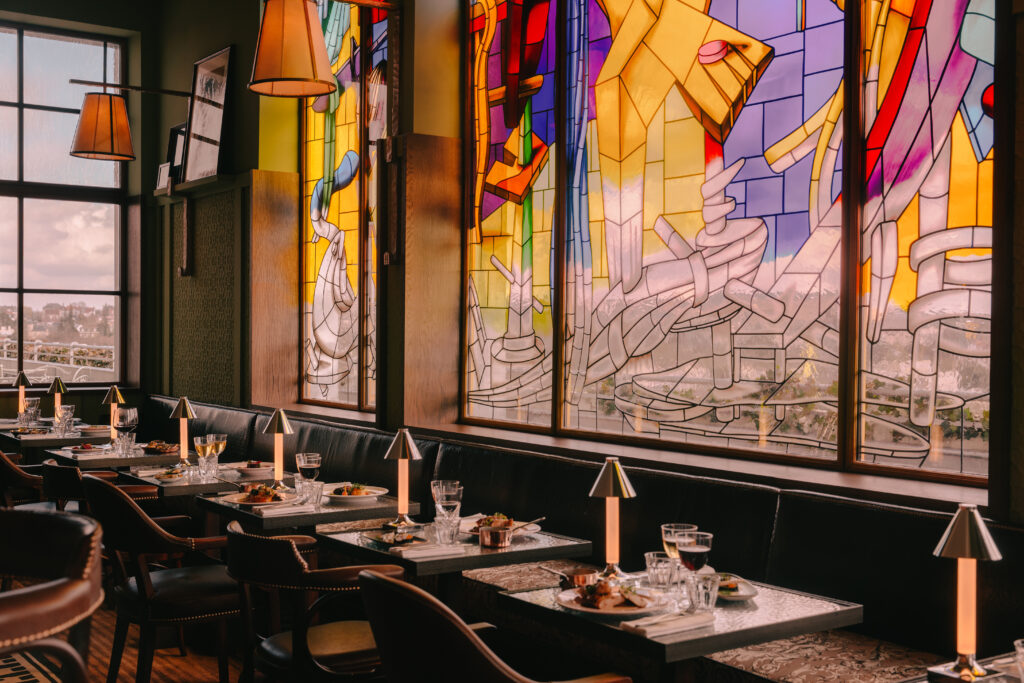
Where the story really comes to its climax on the ninth floor, inside the house itself. La Maison de Manfred, the rooftop restaurant, is the one space where the concept and the craft fuse. The central columns are adorned with Lincrusta's Elizabeth, an embossed wallcovering painted green, its geometric pattern echoing the panelling of 16th-century English interiors. The walls are warmed by terracotta tiles and stacks of logs, and everywhere, memory-filled photographs evoke the history of a place that has always existed. Above it all, Starck's daughter, the artist Ara Starck, has made 19 stained-glass windows, including a monumental one that throws a cathedral-like wash of colour across the hall and out over Metz. "This stained glass invites one into the heart of a conceptual and habitable work of art," she says. "Historical and surrealist symbols of the city's history are etched into it, the whole coming to life with the rhythm of the light." The terraces look out to Fort Queuleu, the Pompidou and the Cathédrale Saint-Étienne.
Back at ground level, La Cuisine de Rose – named for the inventor's imagined love – is a white all-day brasserie with pink touches at the bar, carbon-toned furniture and a giant paper aeroplane hanging over the room. The reception sets immaculate ceramics against dark furnishings. Between them, five "brainstorming rooms" across 300 square metres handle events.
Maison Heler is not a restrained building, and it is not trying to beIt asks whether a fiction can be extruded into steel, stone and zinc and still work as a hotel people want to check into. In the wrong hands, the answer is no – but behind the surreal premise sit a set of genuinely well-made rooms, and one rooftop room that would justify the lift ride on its own. That the fantasy translates as a refined, luxury hotel and not a gimmick is the true measure of Starck's imagination and craft.
Related Articles
How a Franciscan cloister became Four Seasons Cartagena
A 16th-century Franciscan cloister, a 1920s social club and a clutch of old theatres have been knitt...
Read more
The SPACE Edit: our pick of bathroom products to know right now
Sculptural basins, jewel-like brassware and a transparent bath: here is our Editor’s selection of ...
Read more
Objects of desire: Lee McNichol’s little black book of obsessions
Lee McNichol, CEO and Creative Director of Studio Sixty7, shares his latest obsessions and inspirati...
Read more
We'd love to hear from you! Click the button to open the SPACE Magazine Survey and have your say.

Make sure you don't miss a single issue of SPACE by subscribing to receive the magazine. Click the button above to signup.