
Ardbeg House, Islay: Inside Russell Sage’s bold reinvention of a Scottish hotel
From Highland grandeur to Hebridean grit, Russell Sage transforms a backwater Islay hotel into what may be his most expressive work yet
WORDS BY ANDREW HARRIS · IMAGES COURTESY OF ARDBEG HOUSE
As the ferry edges closer through choppy, wintery waters, the russet-coloured hills sweeping straight up from the shoreline into a silvery cigar-tube of cloud are showing signs of human habitation. Not so with the island on the other side of the ship, where the weather-beaten landscape seems to belong solely to the forces of nature. The last time, it suddenly occurs to me, I found myself surveying such a spectacular scene as this, I was floating down an Icelandic fjord.
And while you can’t get to Iceland from Euston, Scotland’s blisteringly raw beauty is readily accessible by rail, and it remains a source of bewilderment why anyone would fly up from London when you can glide gracefully past the Lake District, straight into Glasgow Central and be driving, in no time, alongside the bonnie, bonnie banks of you-know-where, heading towards the Mull of Kintyre, forever eulogised in song by you-know-who. It’s from Kintyre that I boarded the ferry for the crossing to Islay, the southernmost of the Inner Hebrides, just half a mile from its rough-and-ready neighbour, Jura. Deer are regularly spotted swimming between them.
Islay, as any self-respecting whisky drinker will readily attest, is synonymous with whisky production – specifically the distinctive peaty, smoky variety for which the island’s ten distilleries are famous throughout the world and held in reverential esteem by legions of devotees from Hyderabad to Houston.
Last autumn, Ardbeg, one of the older established brands founded in 1815, debuted Ardbeg House, a 12-room hotel in the centre of sleepy Port Ellen, not far from the distillery. What was a nondescript, humdrum hostelry is now totally and indulgently reimagined into anything but, representing Russell Sage Studio’s latest contribution to Highlands and Islands hospitality design.
That journey began with the much-lauded 2019 transformation of the supremely successful Fife Arms in Aberdeenshire, now widely credited as the launch pad for a reinterpretation of Caledonian country retreats, where tired and over-tartaned has been supplanted by inspirational and daringly creative. Sage’s work is at the heart of this upheaval, including The Fish Shop near Balmoral, opened by Charles and Camilla – which sounds like the royal chippy but is, of course, a restaurant with serious sustainability credentials. Russell Sage is also currently preoccupied with another hotel redesign on the ancestral Clan Colquhoun estate around Loch Lomond, scheduled to re-emerge later in 2026.
In 2021, having exorcised any remaining vestiges of middle-management mundanity from a former Glenmorangie corporate events property near its Ross-shire distillery, Russell Sage delivered the exotically reimagined nine-room Glenmorangie House, effectively the forerunner of Ardbeg House. Glenmorangie, now part of LVMH, acquired Ardbeg in 1997 and, as the disarmingly affable Sage explains to me in conversation from his Somerset home, the working relationship with Glenmorangie CEO Caspar MacRae and his team proved particularly gratifying, confiding at one point, “I absolutely adore them!”
How a designer–client relationship transcends that level of mutual understanding is difficult to conceive, but moving straight onto another project must have seemed preordained. At which point, as Sage explains, Glenmorangie made clear that the transformation of what was the Islay Hotel into Ardbeg House needed to be “really quite extraordinary and out there”. Though they needn’t have harboured any concerns – really quite extraordinary and out there is precisely what they got.
Trying to encapsulate a Russell Sage style, or even a brand identity – a term he bristles at – isn’t straightforward. With a plethora of highly acclaimed projects since his studio’s founding in 2005, from The Goring Hotel to the Savoy Grill, and more recently Lilibet’s restaurant, Sage has delivered some staggeringly beautiful work. Opulent and sumptuous, with a boundary-defying eclecticism all underpinned by a deeply held respect for craftsmanship, Russell Sage – brand identity or no – charts his own dazzling course.
I did wonder, though, if Ardbeg House might be the clearest manifestation yet of Russell Sage let off the leash, to which he readily acknowledges, “Yeah, probably.” Although the free-spirited, rebellious and non-conformist picture that Islay likes to paint of itself did set the stage for some sort of synergy. As Sage confirms, “At that point the interior design shackles came off!”
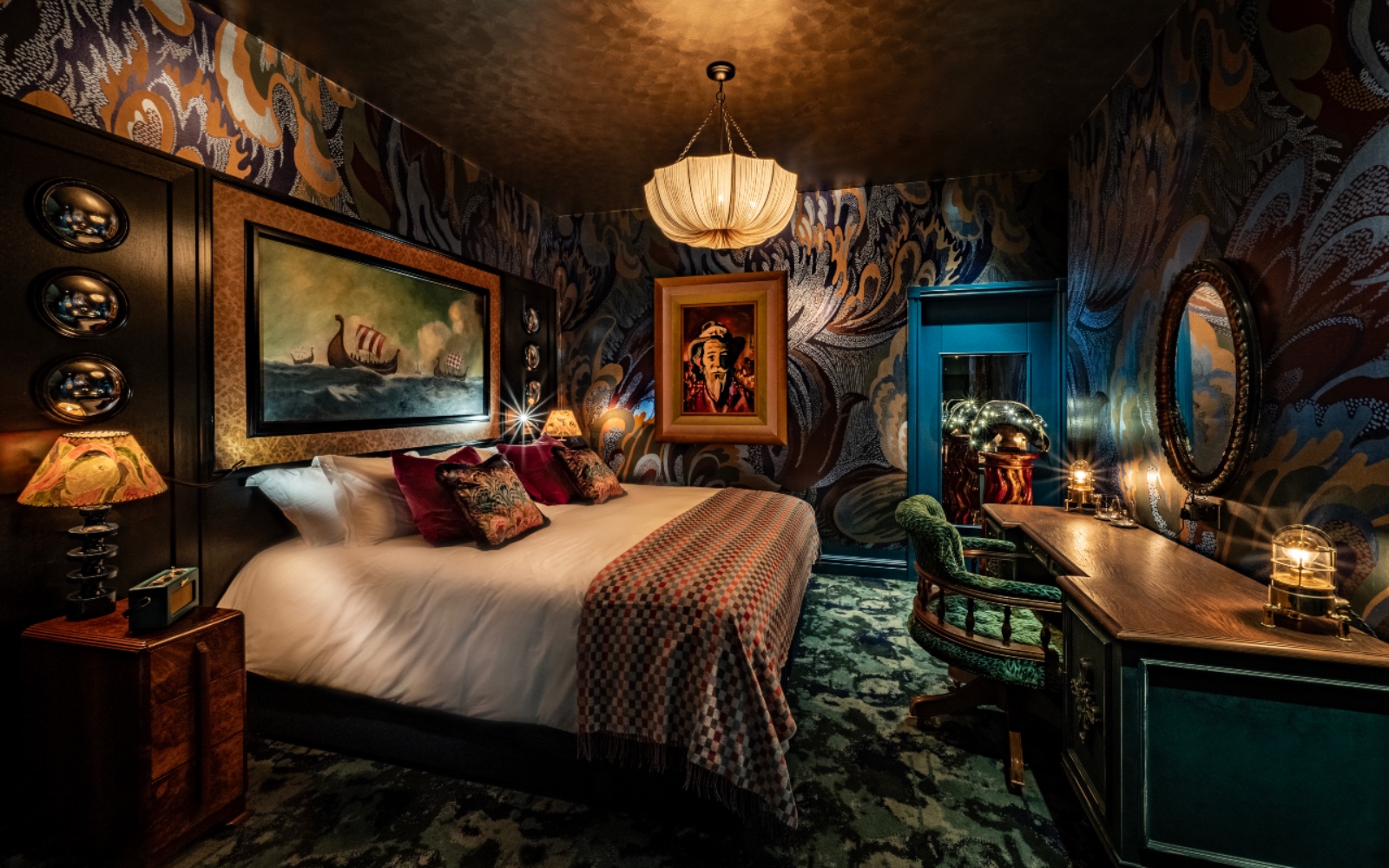
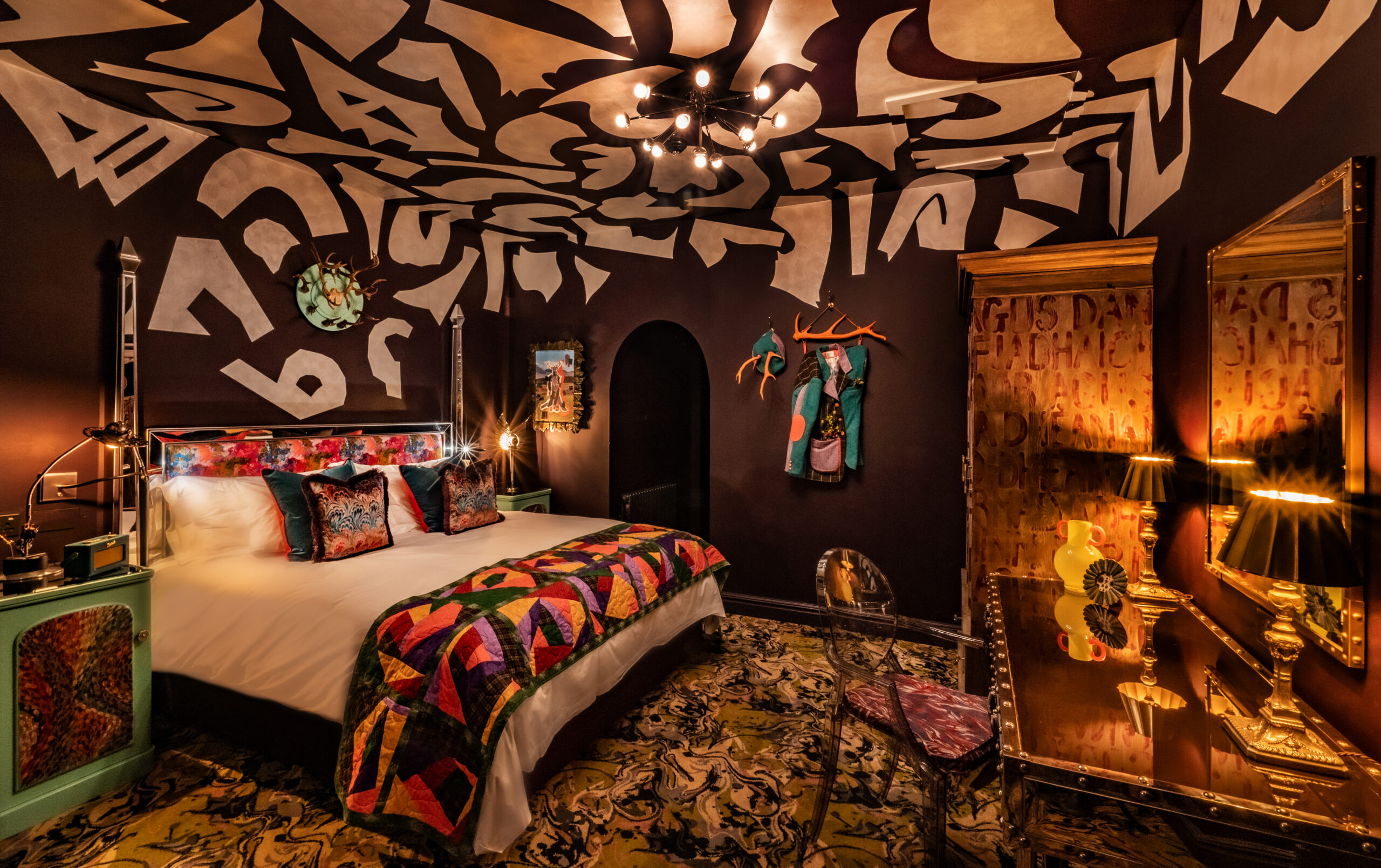
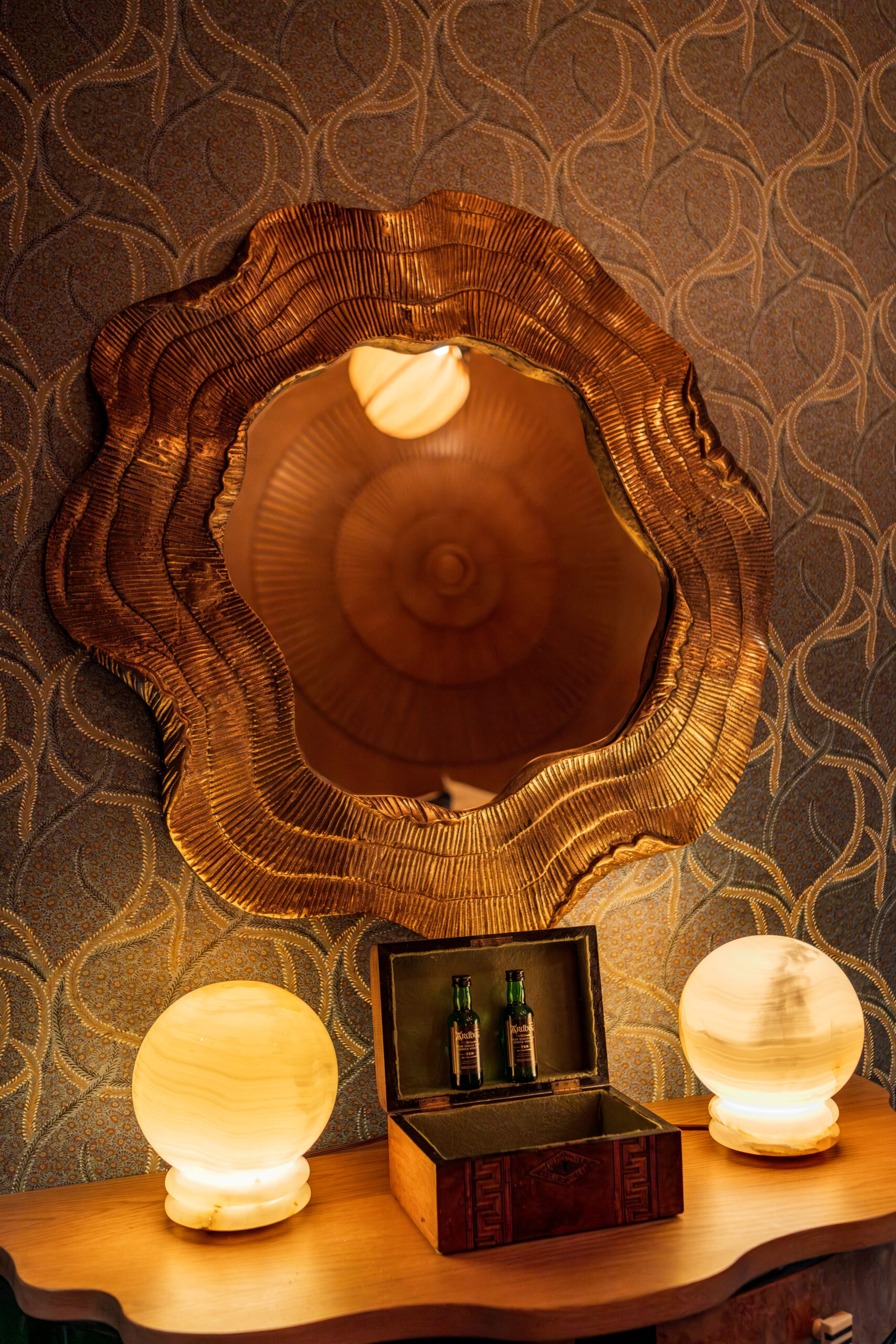
Another established feature of the designer’s modus operandi is framing projects around storytelling, and Ardbeg House is infused with the island’s limitless supply of legends, seafaring history and Norse mythology, each room designed around a particular aspect of Islay’s identity. The Monster Room has alligator wallpaper referencing one of the island’s many mythical beasts, the “Islay-gator”, an alligator-type creature lurking in the peat bogs for unwary peat cutters. The Illicit Room, celebrating centuries of smuggling and revenue dodging, has a croft-style bed crafted from beachcombed timber. On the bed in the Smoke Room, paying homage to the island’s peaty heritage (Ardbeg is supposedly the peatiest of the peaty), there’s a faux-leather headboard made to resemble stacked peat. And so it continues, with this unrestrainedly rich amalgamation of repurposed materials, custom metalwork, individually commissioned pieces and local artworks, embellished by 24 Fromental wallpapers, Tisseré-designed carpets and Timorous Beasties fabrics.
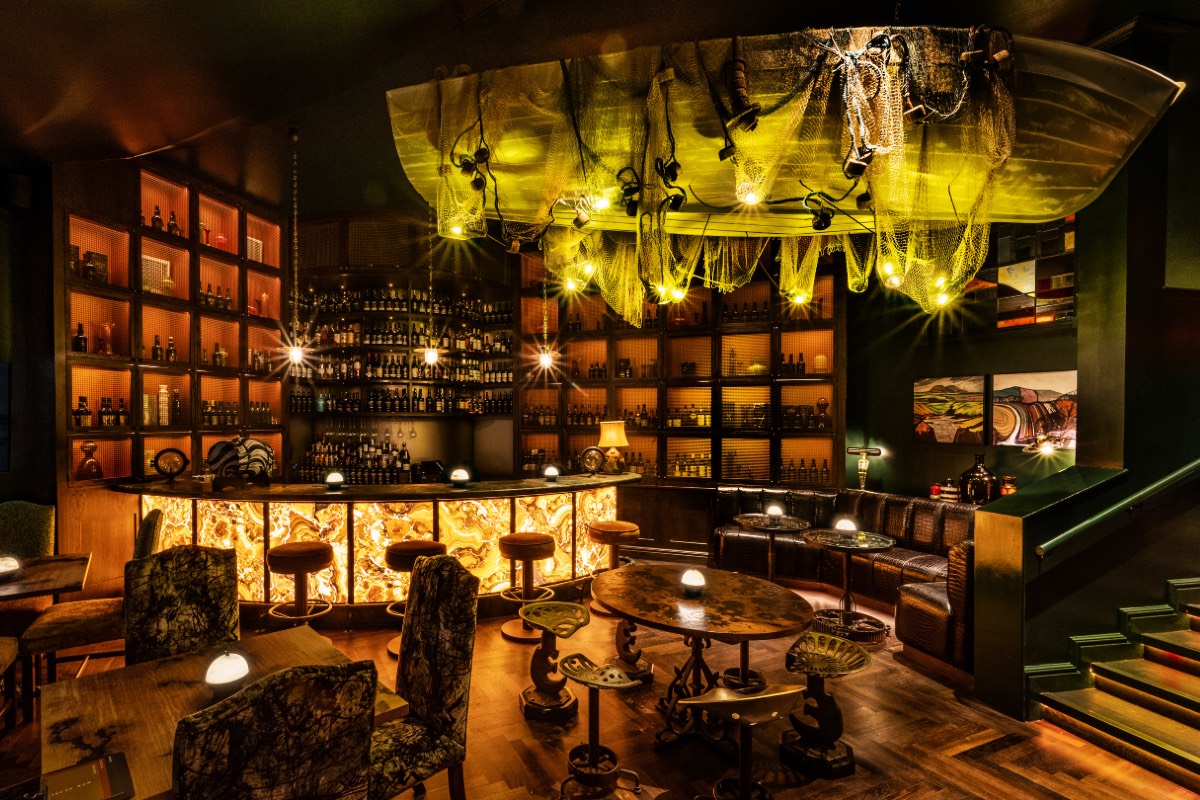
The bar, a longstanding firm fixture for locals, has kept pricing accommodative accordingly, though it must have seemed to some as if their unprepossessing little watering hole had suddenly morphed into the Spaceport Cantina from Star Wars. Locals and hotel guests alike, however, were all having a great time underneath the Ardbeg bottles dangling from the boat chandelier (yes, a full-sized boat) amidst the glare of the green Pisani marble-topped bar when I popped in for a dram of Badger Juice – an Ardbeg whisky available only to the hotel.
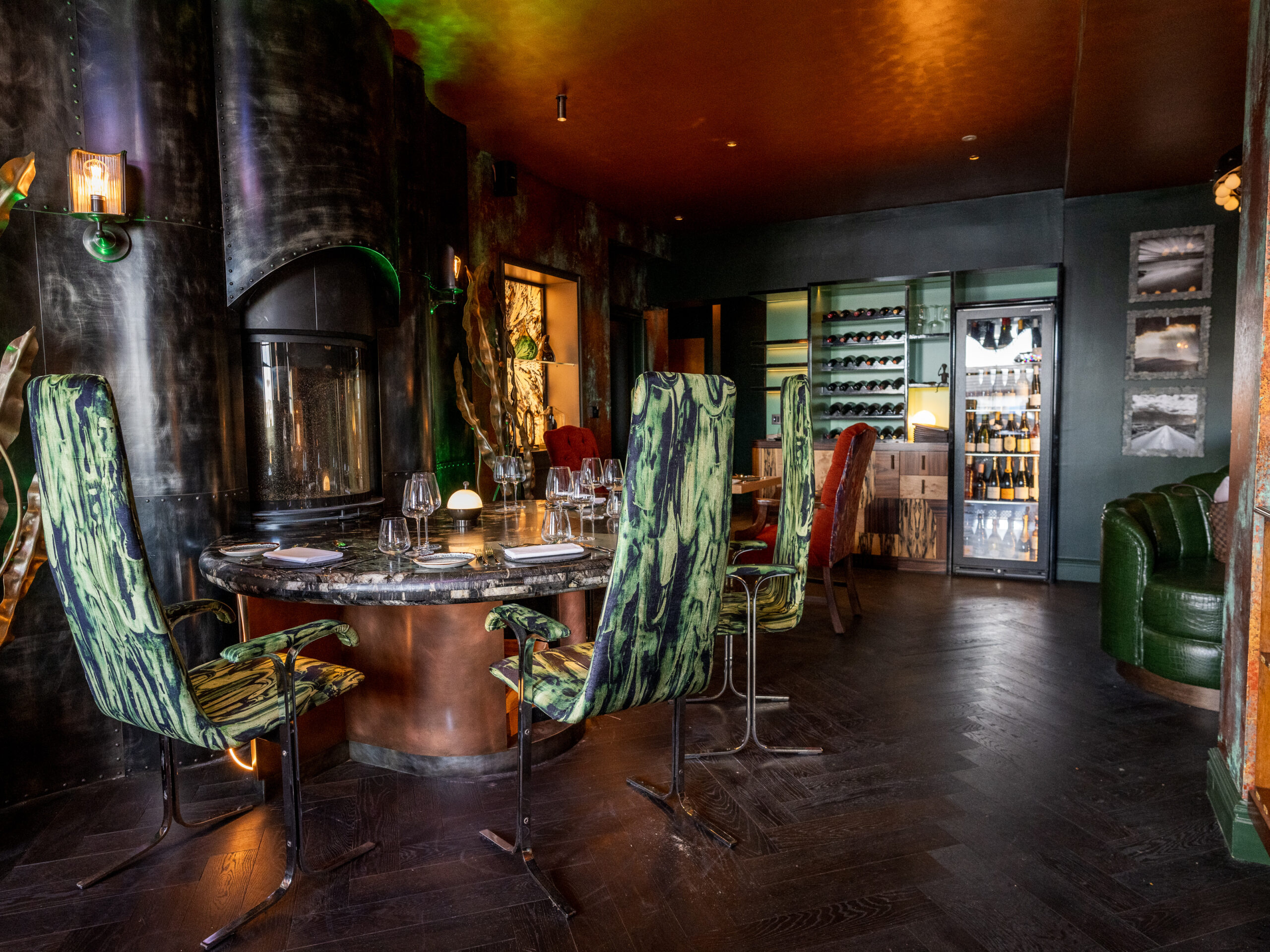
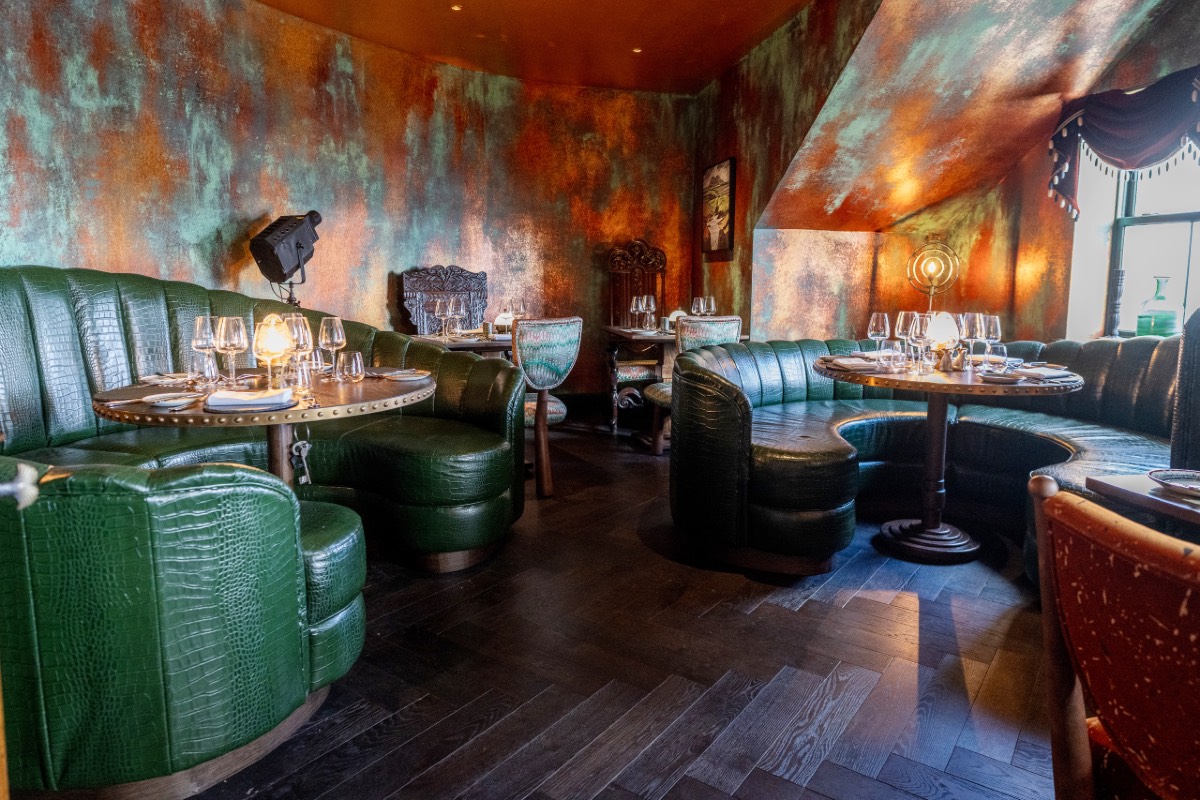
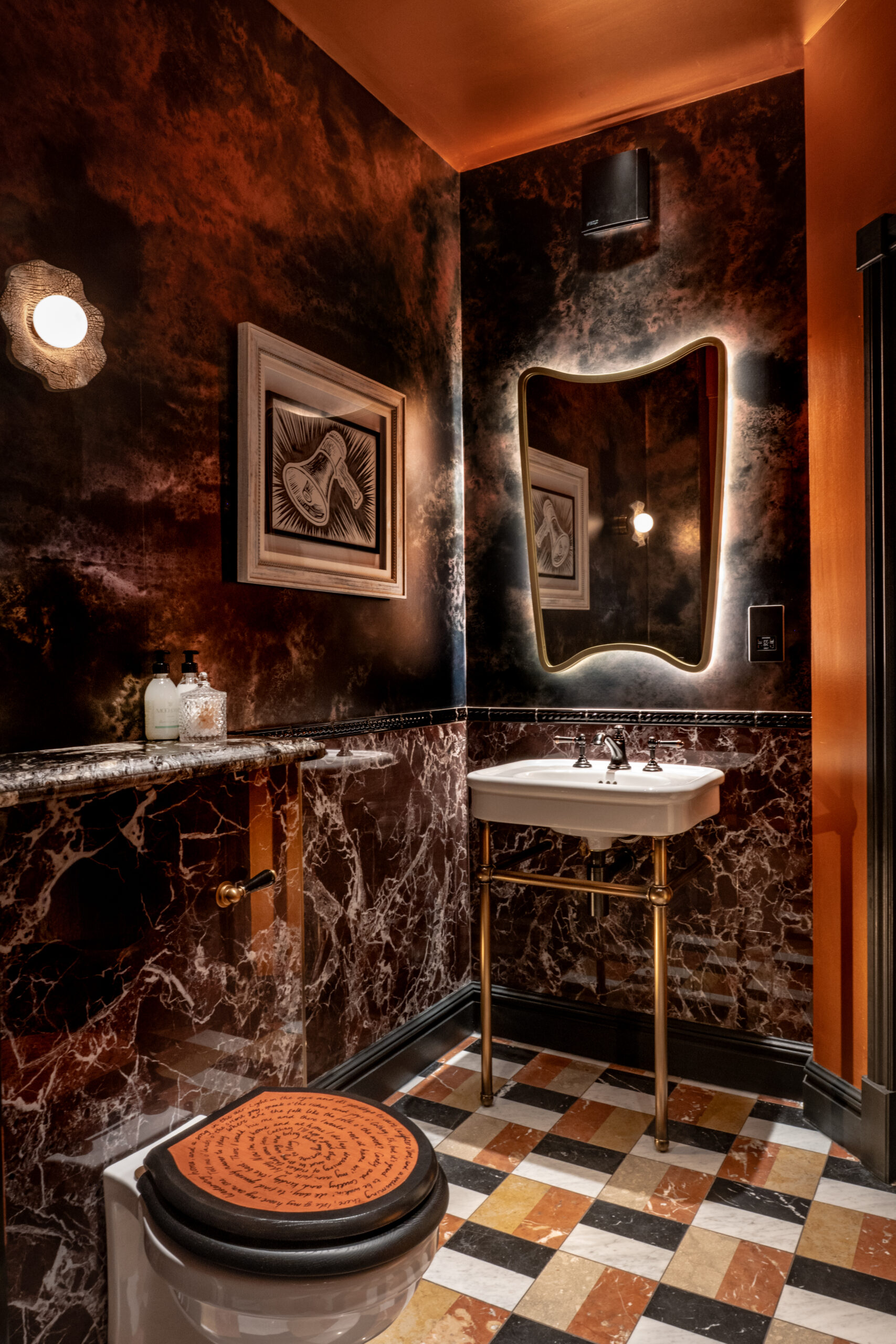
The restaurant, serving an excellent menu anchored around some of the best seafood to be found anywhere, local black-faced lamb, foraged foods and venison, features a large table arranged around a custom-built peat-burning fire for communal dining. Adjacent is an alluring private dining room where intricate wood-veneer tabletops on metal seaweed-shaped frames sit next to a wall of whisky bottles crafted from copper, referencing copper whisky stills. All presided over by an octopus chandelier – obviously. The bathrooms, with their washbasins made from car tyres, were a particular highlight of this unrestrained romp through the outer reaches of interior design eccentricity.
Russell Sage readily accepts that all of this thrown together ran the risk of looking, as he puts it, “a bit steampunk”. In addition to his predilection for reclaimed and repurposed materials – he has four people sourcing pieces full-time, 10,000 of which, including fully panelled rooms, are stored in huge barns – there’s also his endearing habit of embracing the local community. It seems that anyone turning up at the front door with an artwork or bit of memorabilia is never turned away. The Fife Arms, he informs me, contained 18,000 items, with a grandfather clock and a stag’s head brought in just two days before opening. Admittedly, with The Fife owned by the art world’s pre-eminent power couple, Iwan and Manuela Wirth, many of those artworks – including Picassos and Lucian Freuds – were curated by them, though clearly many were not.
The Ardbeg project has enjoyed a similarly inclusive approach towards Islay’s 3,000 residents and has been instrumental in embedding the quintessential sense of place that Sage sought to instil into the property from the outset.
What stops this barking-mad mix of materials and methodologies from degenerating into a grungy steampunk experiment is, of course, Russell Sage’s complete mastery of his métier. The 40-strong studio, supported by a diverse assortment of craftspeople and artists, spent three years meticulously moulding Ardbeg House into the polished end product now ready to be chaperoned into its first summer by relentlessly charming GM Richard Needham, formerly of The Fife Arms, and his delightfully laid-back team.
The Fife Arms, where Sage was back working recently, is, it seems, never far from the conversation – and with good reason. For myself and many others, the award-winning property remains a firm favourite, though the way Russell Sage articulated his personal perspective on the two hotels was illustrative: “I think The Fife is how I would have my own home, put it that way. Ardbeg is closer to where I’d take my friends to a bar.” Succinctly put – mine’s a Badger Juice.
Related Articles
Mexico’s Hotel Boom: New Luxury Resorts, Design Trends and Emerging Destinations
With millions of visitors and hundreds of new projects in development, Mexico’s hospitality secto...
Read more
Six Exceptionally Designed Hotel Lobbies Across the Globe
Whether grand and glamorous, or small and intimate, there’s no doubt when designing a hotel lobby...
Read more
Visionaries: Afroditi Krassa on blending art, experience and effectiveness in design
As the creative force behind Michelin-starred restaurants, A-list bars and luxury hotels, Afroditi ...
Read more
Anthology by Style Library Contract
Testimonials
“SPACE has excellently researched, well-rounded, and informative editorial, presented in a stylish glossy layout, which is ideally suited to the calibre of our clients. The team, both editorial and advertising, are knowledgeable, helpful, and fun. Working with them is always a pleasure.”
Karen Brooks, Esprit Media Ltd
“Working closely with Space magazine, means that Barlow Tyrie products are seen by the right target audience and relative to premiere outdoor garden spaces.”
Steven Still, Barlow Tyrie
"Armourcoat has partnered with Space Magazine since launch in 2015, and is now regarded as an essential part of our international marketing strategy. Recognising the scale of subscribers and quality of content, we truly value the opportunity the platform (both in print and digital) presents."
Daniel Nevitt, Armourcoat
"We have partnered with SPACE Magazine since it’s launch and SPACE have now become one of our most influential media partners. Their readership of senior hoteliers and interior designers are exactly the audience we invite to attend the Independent Hotel Show and SPACE delivers on helping us position our brand in front of them. Not only does SPACE have the readership we want but they also work with us to tailor content they think is right which when time poor is much needed. I couldn’t recommend SPACE enough."
Sam Chance, Fresh Montgomery